ENTAV Chardonnay clone 1066 with much improved fruitset this year
Featured Post
Tuesday, January 16, 2018
Tuesday, October 31, 2017
Pontac
Pontac
Synonyms
Dix fois
coloré — ‘coloured 10 times’, Teinturier mâle (France); Färbertraube, Tintewein
(Germany); Pontacq, Pontak (South Africa).
Origin and cultivation
background
Pontac is
one of the oldest cultivars in South Africa and was probably cultivated in Van
Riebeeck’s time, but definitely in the Van der Stel era. As early as 1772, the
Dutch ship De Hoop carried, along with other wines and brandies, a leaguer of
Pontac to the Netherlands, where it was sold at a price four times that of
Chenin blanc.
Prof.
Perold proved that Pontac is similar to Teinturier mâle. Documentary evidence
that the early Cape cultivars came from France (probably from western and
south-western France) posed the question whether South African Pontac might
have a connection to the famous Pontac family of Bordeaux, after whom the small area south of
Bordeaux is named. Until relatively recently, fortified sweet Pontac was quite
popular in South Africa, but it hardly exists any more. The cultivar is still
grown, however, with limited quantities found in all the regions, except for
the Orange River and Paarl areas.
Cultivation characteristics
Pontac
has moderate vigour and a semi-upright growth habit. Grows best on relatively
fertile soils in the warmer regions. The yield potential is medium to low
because of its small bunches. Despite the high fertility of the basal buds, cane
pruning and low trellising are often utilised in order to achieve satisfactory crops.
Susceptible to oidium but reasonably resistant to other diseases — a normal
spray programme should be followed, however. Under ideal conditions it produces
a rich, red juice with a very strong, characteristic bouquet that can be used
with great success to produce fortified, sweet Pontac wines. Good compatibility
with commercial rootstocks.
GENERAL CHARACTERISTICS
Yield potential
8 -10
tons per ha
Average sugar concentration
23—2 5°B
Average acid concentration
8—9 g/l
Clone characteristics :
The
available clones are characterised by good quality stable colour, and grass and
berry
flavours.
MORPHOLOGY :
Shoot tips
Felty,
white with violet-red colouration around the margins.
Leaves
Small, round,
five-lobed, dark green, markedly blistered, downy underneath. The petiole sinus
is lyre-shaped and closed to overlapping. .
The
apical and middle sinuses are reasonably deep and open. The teeth are short,
blunt and convex. The petiole is red. Leaves often display early autumn colours
(probably as a result of leaf roll infection).
Bunches
Small,
cylindrical to somewhat conical, usually fairly compact. The peduncle is short,
thick
and
tough.
Berries
Medium-sized,
practically round, dark black when fully ripe with moderate bloom. The skin
is thick
and tough. The pulp ¡s blood red with little juice when fully ripe. Coloured
juice. The
brush is
blood red.
PHENOLOGY
Bud burst
First
half of September.
Flowering
End of
October to first half of November.
Ripening
Mid-season,
first half of March.
(Grape Cultivars for wine Production in South Africa – PG Goussard)
Tuesday, July 11, 2017
New varieties for the future
According to Jose Vouillamoz co-author of Wine Grapes: A Complete Guide to 1,368 Vine Varieties, Including Their Origins and Flavours Hardcover , 2012 with Jancis Robinson (Author) and Julia Harding (Author), the following varieties will be the new stars of the future. The varieties are currently obscure. .
Italy has 377 varieties commercially to make wine.
France
Spain
Portugal
Greece
Switzerland has 39 varieties and 15 000 hectares
Croatia
Hungary
Georgia Claims to have 525 varieties but José says they aren’t all different
Turkey
Austria
Armenia
Italy has 377 varieties commercially to make wine.
- Timorasso 20 ha currently – Piemonte white variety very aromatic, not easy to grow but many producers replanting this. The new star.
- Mammolo 147 ha – Tuscany – grown in Corsica too. Much fruit, soft tannins
- Nieddera 60 ha – Sardinia – has structure and nice body and has been rescued by Contini
- Teroldego 839 ha – Trentino – lots of colour and fruit, very alpine. Fresh with bitterness. Grows pergola or gobelet. See Foradori for good examples.
France
- Douce Noir 2 ha – Savoie. Used to be the most widespread variety in the region. In Argentina they have more than 18 600 ha of this, which they call Bonarda.
- Counoise 443 ha – South of France, and one of the permitted varieties in Chateauneuf – brings spices – soft and aromatic
- Tibouren 445 ha- Provence, mostly rose wines but excellent reds, such as Clos Sibon. Wines with personality, structure and fruity aromas.
Spain
- Graciano 1468 ha – ‘I’d like to see more of this,’ says José. ‘I love these wines in Sardinia.’ Tinta Miuda in Portugal
- Garro 2 ha – part of the Torres rescue program in Catalonia. Very promising.
- Gorgollasa 4 ha Majorca
Portugal
- Alvarelhao 67 ha – from the Minho Rabigato 2452 ha – Douro
- Alfrocheiro 1492 – Dão, Lisboa
- Jampal 106 ha – Lisboa
Greece
- Limniona 10 ha
- Chidiriotiko 60 ha – the pinot of Greece from lesbos
- Kydonista 10 ha
Switzerland has 39 varieties and 15 000 hectares
- Arvine 173 ha
- Rouge du Pays/Cornalin 135 ha
Croatia
- Lasina 10 ha – light red with soft tannins
- Svrdlovina Crna 1 ha just one producer, everyone amazed by this wine at a recent conference
Hungary
- Ezerjo (1665 ha)
- Fekete Jardovany (2 ha)
Georgia Claims to have 525 varieties but José says they aren’t all different
- Kisi – 50 ha
- Shavkapito – 10 ha
Turkey
- Emir 92 ha – light-bodied white Bogazkere
Austria
- Sankt Laurent 795 ha – a child of Pinot
- Zierfandlen
Armenia
- Voskeat – white Areni – ‘for me one of the best varieties of the world, Armenia’s Nebbiolo’
Thursday, December 15, 2016
Friday, September 16, 2016
New varieties from Vititec
Since 2007 Vititec
imported 60 new clones and 15 new cultivars from ENTAV, France, as part of our
ongoing process to introduce new cultivars to the South African Wine industry.
Ongoing climate change affects the characteristics of the
grape harvest in many wine regions. Some
of these varieties, mainly from the Mediterranean area, can be the South
African wine producers answer to adapt to climate change.
New
cultivars include among others Arinarnoa, Marselan, Macabeu, Piquepoul blanc, Sauvignon gris and
Vermentino.
The
following amount of vines have been allocated for planting in 2016:
|
Arinarnoa
|
135
|
|
Counoise
|
165
|
|
Macabeau
|
917
|
|
Marselan
|
128
|
|
Piquepoul blanc
|
298
|
|
Vermentino
|
2995
|
The
following amount of vines were grafted for planting in 2017:
|
Counoise
|
1125
|
|
Macabeu
|
1755
|
|
Marselan
|
405
|
|
Piquepoul blanc
|
495
|
|
Terret noir
|
180
|
|
Vermentino
|
7268
|
Friday, June 24, 2016
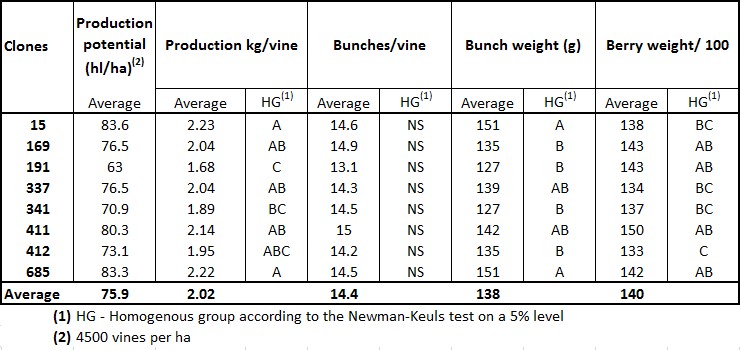
Cabernet Sauvignon ENTAV-INRA® N° 412
Imported by Vititec in 2008 and released
from quarantine in 2009, this clone was first planted in 2014 in South Africa.
According to French data, this clone originates in Gironde and is an earlier
maturing clone. In experimentation carried out in Languedoc and Bordeaux, this
clone has medium to lower fertility, bunch and berry weights. It has shown a
lower production potential, high sugar content, medium acidity, and medium to
superior anthocyanin and polyphenolic content.
Wines are appreciated due to their balance
structure and tannins with and their very good ageing potential.
Summary
As can be seen in table 1 and figure 1,
clone 412 has similar final wine composition and quality characteristics to
ENTAV-INRA N° 337 which has been considered the reference clone
in Bordeaux.
Wednesday, June 22, 2016
These are the best wines in South Africa in 2016
Source: http://businesstech.co.za/news/lifestyle/127345/these-are-the-best-wines-in-south-africa-in-2016/
Subscribe to:
Posts (Atom)