Featured Post

Vititec clone information 2024

Tuesday, July 11, 2017

New varieties for the future

According to Jose Vouillamoz co-author of Wine Grapes: A Complete Guide to 1,368 Vine Varieties, Including Their Origins and Flavours Hardcover , 2012 with Jancis Robinson (Author) and Julia Harding (Author), the following varieties will be the new stars of the future. The varieties are currently obscure. .

Italy has 377 varieties commercially to make wine.

  • Timorasso 20 ha currently – Piemonte white variety very aromatic, not easy to grow but many producers replanting this. The new star.
  • Mammolo 147 ha – Tuscany – grown in Corsica too. Much fruit, soft tannins
  • Nieddera 60 ha – Sardinia – has structure and nice body and has been rescued by Contini
  • Teroldego 839 ha – Trentino – lots of colour and fruit, very alpine. Fresh with bitterness. Grows pergola or gobelet. See Foradori for good examples. 


France 

  • Douce Noir 2 ha – Savoie. Used to be the most widespread variety in the region. In Argentina they have more than 18 600 ha of this, which they call Bonarda. 
  • Counoise 443 ha – South of France, and one of the permitted varieties in Chateauneuf – brings spices – soft and aromatic 
  • Tibouren 445 ha- Provence, mostly rose wines but excellent reds, such as Clos Sibon. Wines with personality, structure and fruity aromas. 


Spain 

  • Graciano 1468 ha – ‘I’d like to see more of this,’ says José. ‘I love these wines in Sardinia.’ Tinta Miuda in Portugal 
  • Garro 2 ha – part of the Torres rescue program in Catalonia. Very promising. 
  • Gorgollasa 4 ha Majorca 


Portugal 

  • Alvarelhao 67 ha – from the Minho Rabigato 2452 ha – Douro 
  • Alfrocheiro 1492 – Dão, Lisboa 
  • Jampal 106 ha – Lisboa


Greece 

  • Limniona 10 ha 
  • Chidiriotiko 60 ha – the pinot of Greece from lesbos 
  • Kydonista 10 ha 


Switzerland has 39 varieties and 15 000 hectares

  • Arvine 173 ha 
  • Rouge du Pays/Cornalin 135 ha 


Croatia

  • Lasina 10 ha – light red with soft tannins 
  • Svrdlovina Crna 1 ha just one producer, everyone amazed by this wine at a recent conference 


Hungary 

  • Ezerjo (1665 ha) 
  • Fekete Jardovany (2 ha) 


Georgia Claims to have 525 varieties but José says they aren’t all different

  • Kisi – 50 ha 
  • Shavkapito – 10 ha 


Turkey

  •  Emir 92 ha – light-bodied white Bogazkere 


 Austria

  • Sankt Laurent 795 ha – a child of Pinot 
  • Zierfandlen 


 Armenia

  •  Voskeat – white Areni – ‘for me one of the best varieties of the world, Armenia’s Nebbiolo’

Friday, September 16, 2016

New varieties from Vititec

Since 2007 Vititec imported 60 new clones and 15 new cultivars from ENTAV, France, as part of our ongoing process to introduce new cultivars to the South African Wine industry.

Ongoing climate change affects the characteristics of the grape harvest in many wine regions.  Some of these varieties, mainly from the Mediterranean area, can be the South African wine producers answer to adapt to climate change.

New cultivars include among others Arinarnoa, Marselan,  Macabeu, Piquepoul blanc, Sauvignon gris and Vermentino.

The following amount of vines have been allocated for planting in 2016:

Arinarnoa
135
Counoise
165
Macabeau
917
Marselan
128
Piquepoul blanc
298
Vermentino
2995

The following amount of vines were grafted for planting in 2017:


Counoise
1125
Macabeu
1755
Marselan
405
Piquepoul blanc
495
Terret noir
180
Vermentino
7268

Friday, June 24, 2016

Cabernet Sauvignon ENTAV-INRA® N° 412

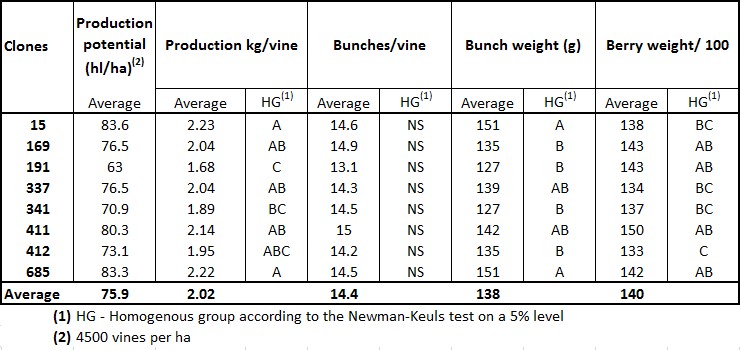
Imported by Vititec in 2008 and released from quarantine in 2009, this clone was first planted in 2014 in South Africa. According to French data, this clone originates in Gironde and is an earlier maturing clone. In experimentation carried out in Languedoc and Bordeaux, this clone has medium to lower fertility, bunch and berry weights. It has shown a lower production potential, high sugar content, medium acidity, and medium to superior anthocyanin and polyphenolic content.

Wines are appreciated due to their balance structure and tannins with and their very good ageing potential.

Summary


Production measured at Domaine du Grand Parc a Latresne, Bordeaux


As can be seen in table 1 and figure 1, clone 412 has similar final wine composition and quality characteristics to ENTAV-INRA N° 337 which has been considered the reference clone in Bordeaux.

Wednesday, June 22, 2016

These are the best wines in South Africa in 2016

Source: http://businesstech.co.za/news/lifestyle/127345/these-are-the-best-wines-in-south-africa-in-2016/

Tuesday, May 10, 2016

Petit Verdot

Petit Verdot is a very old, well-established cultivar from the Médoc in France. Due to the good colour and tannin structure it is mostly used as a blending partner. 

Petit Verdot is a late ripening cultivar that only ripens fully in the warmer vintages of Bordeaux. The plantings in France declined from 685 hectares in 1958 to the current 380 hectares due to its inconvenient late ripening. 

Under the warmer South African conditions, Petit Verdot ripens late mid season (end of February to middle March) with average vigour and good production. In Stellenbosch the average production is 5-7 kg/vine with a must acidity of 7-9 g/l at 23-25 ºB. The bunches are average to large and the berries are even smaller than those of Cabernet Sauvignon.


The three clones available in South Africa, PR 400, PR 8719 and PR 1058 are all from French origin. PR 400 and PR 8719 are very fertile and crop control is necessary. The wines are concentrated, tannic and rich in colour with spicy, peppery flavours.


PR 1058 from ENTAV has lower fertility and below average production with full balanced wines and good colour.


 Clone comparison of of Petit Verdot N

- Appellation: Médoc- Rootstock: 101-14 MGt

- Soil: sandy

- Planting density: 6500 vines per hectare


Summary

Clone 1058 is less productive because it is less fertile than clone 400. Clone 158 provides the richest wines in total polyphenols with a higher color intensity. The evaluation was performed on an early ripening site. In another site in a cooler terroir, 1058 was ripening much later than clone 400 and has struggled to ripen properly

Thursday, April 14, 2016

Greek varieties suitable for climate change

Fifty Greek varieties has been introduced into France to study their suitability for use in the changing climate. Five of them were the subject of registration and a listing in the French national catalog: Aghiorgitiko N, AssyrtikoMoschofilero RsRoditis Rs Xynomavro N. 

"They have to keep a main characteristic of aromatic freshness even in the conditions water stress and high temperatures in Greece, "said Laurent Audeguin. This indicates that among these five varieties, Moschofilero Rs appears promising, bringing together both productive characters and good acidity. Their propagation is underway and should be available within two years. 
Moschofilero
Although there are several differently coloured clones of this aromatic, late-ripening Greek variety, most vines produce pink- or grey-skinned grapes which are used to produce white wines.
Image: Moschofilero by Elisavetch at Greek Wikipedia
Its likely origin and most common home is in the centre of the Peloponnese, where the Mantinía appellation requires 85% Moschofilero.

It has high acidity and sometimes struggles to ripen, rarely reaching more than about 11% alcohol, especially at elevations of 600m or higher on the Mantinía plateau. On warmer sites, the variety can yield richer wines but, whatever the style, these white wines are characterised by grapey and floral aromas, ranging from delicate and stony to intensely fragrant with fruit flavours such as citrus and even apricot. The best examples are not only highly aromatic but also deliciously refreshing and quaffable. The use of oak is rare but some producers, such as Tselepos and Spiropoulos, make both oaked and unoaked versions.